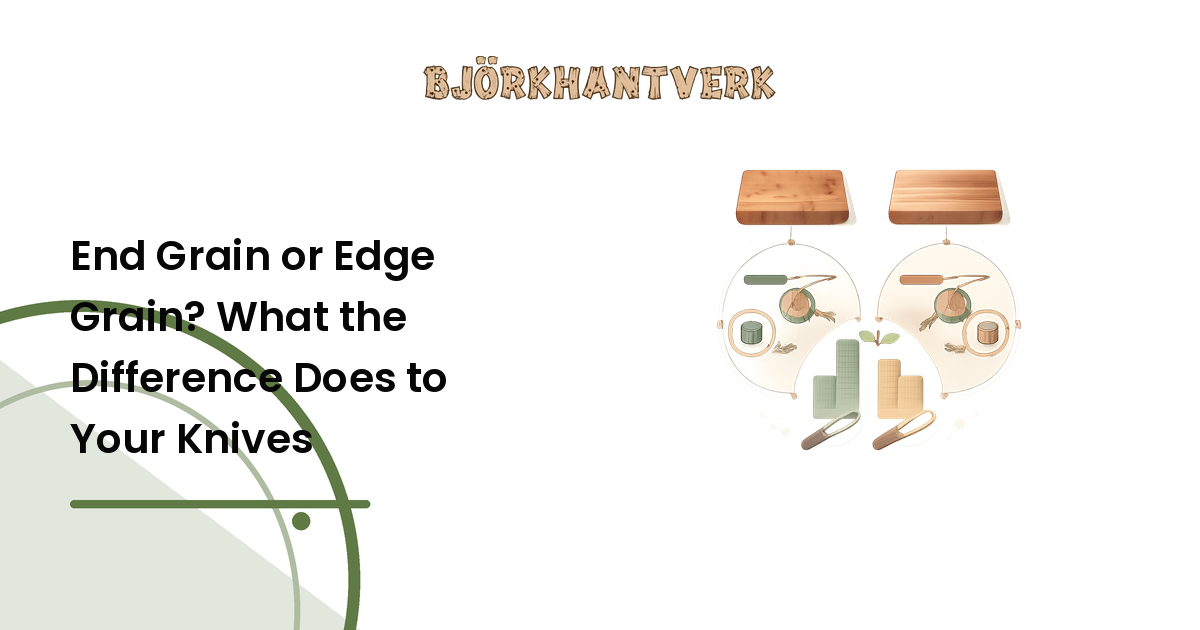
Two boards sit side by side. Same wood, same size, and one costs noticeably more. Nothing on the surface explains it, because the difference is not on the surface — it is in which direction the wood fibres are pointing.
The takeaway up front: an end grain board presents the open ends of the fibres to your knife, so the edge parts them and settles between them. An edge grain board presents the sides of those fibres, so the edge cuts across them. That single distinction drives everything else — how the board wears, how long your knives stay sharp, what the board weighs, and what it costs.
What you are actually looking at
Picture a handful of drinking straws held in a bundle.
Lay the bundle down and slice across it, and you are cutting through the walls of every straw. That is an edge grain board: long strips of wood glued side by side, with the growth rings running along the length. It is the construction most wooden boards use, and the surface you see is the side of the timber.
Now stand the bundle upright and cut down into the open ends. The blade slides into the gaps rather than severing anything. That is an end grain board — sometimes called a butcher block — built from short blocks stood on end and glued together, so the surface you see is the cut end of the timber. On Björkhantverk's end grain boards you can read this directly: the growth rings face upwards, and the chequerboard pattern is the ends of individual blocks.
Swedish shops label these ändträ (end grain) and stavlimmad (stave-glued, which is edge grain). Once you know to look at the end of the board rather than the top, you can tell them apart in a second.
What it does to a knife edge
A knife edge is a very thin wedge of steel, and it dulls by rolling over microscopically rather than by wearing away.
On edge grain, every chop lands the edge against fibre walls. The wood resists, the edge takes the impact, and over time it deflects. The board copes well — it is a hard, stable surface — but your knife is doing the yielding.
On end grain, the fibres part. The edge slips between them and the wood closes back around it. Two things follow. The knife meets far less resistance, so it holds its sharpness longer. And the board does not carry a permanent scar, because nothing was severed — the fibres spring back. This is why end grain boards are often described as self-healing, and why a well-used one looks better after a year than a cheap edge grain board does after a month.
The trade-off is real: that same softness means an end grain board absorbs more moisture and needs oiling more diligently. Nothing is free.
Weight, thickness and the practical bit
End grain construction needs thickness to be stable. A board built from short blocks standing on end has to be deep enough that the blocks cannot tip or work loose, which is why end grain boards are noticeably chunkier — Björkhantverk's classic pine end grain board is around 5 cm thick, and the butcher block with the juice groove is deeper still.
That thickness is the point when you are breaking down a chicken or working through a pile of root vegetables: the board does not skate, it does not flex, and it absorbs the impact instead of transmitting it into the worktop. It is also the reason you probably will not be lifting it one-handed to tip carrots into a pan.
An edge grain board, at the same footprint, is lighter and easier to move. If your board lives on the counter and gets used for everything, that matters more than you would expect.
Which one should you buy?
Choose end grain if you cut most days, own knives you care about, and want a board that will outlive several cheap ones. It rewards the oiling routine and punishes neglect.
Choose edge grain if you want something lighter to handle, you are buying a serving or bread board as much as a chopping board, or you simply want a good wooden board without the higher price. It is not a compromise — it is a different tool. A long, narrow birch serving board is meant to carry cheese to a table, not to take a cleaver.
And be honest about the oiling. An end grain board that never gets oiled will dry out and open up at the glue lines. An edge grain board that gets oiled occasionally will be fine for years. The best board is the one whose upkeep you will actually do — which is the subject of the next piece.
Frequently asked questions
Is end grain really better, or is it marketing? It is a genuine mechanical difference, not a story. The fibres part instead of being cut, so the edge meets less resistance and the surface closes back up. Whether that difference is worth the extra weight and upkeep depends on how much you cut.
Will an end grain board blunt my knives less? It is gentler on an edge than edge grain, and far gentler than glass, stone or bamboo. It will not keep a knife sharp forever — nothing does. You will still hone and sharpen, just less often.
Can I tell which one I already own? Look at the end of the board. If you can see growth rings and the ends of individual blocks, it is end grain. If you see long continuous strips running the length, it is edge grain.
Does end grain need more looking after? Yes. The open fibre ends take up moisture more readily, so it wants oiling more regularly and should never sit wet or flat in a puddle. Dry it upright.
If you want to see the difference in the wood itself, the boards in the Björkhantverk workshop are listed by construction — ändträ for end grain, stavlimmad for edge grain — over at bjorkhantverk.se.
About the author — Björkhantverk makes cutting boards, serving boards and wooden butter knives by hand from birch and pine in Hälsingland, Sweden.