Ask which wood is better and you will get an argument. Ask which wood suits the board you have in mind, and there is usually a clear answer.
The takeaway up front: birch is denser and harder, so it takes daily knife work well and stays smooth; pine is lighter and softer, so it makes a big board you can actually lift. Neither is the premium option and neither is the budget one. They are different materials that fail in different ways, and a workshop that uses both is choosing per board, not cutting corners.
Two woods, side by side
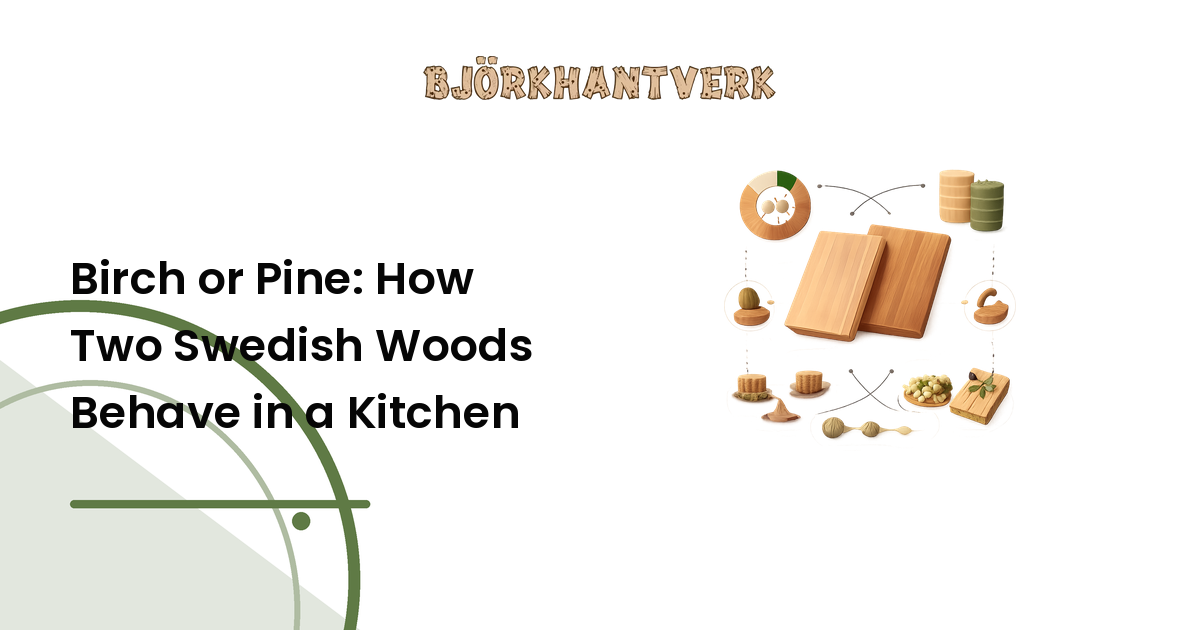
Birch (björk) is a pale, fine-grained hardwood with a tight, even texture and very little figure. It is noticeably dense for a pale wood, and it takes a smooth surface that stays smooth. In a kitchen that means it resists scoring, handles a knife landing on it day after day, and keeps a clean look rather than developing a rough nap. It is also heavier — a large birch board is a two-handed object.
Pine (furu) is a softwood: lighter in the hand, warmer in colour, and it carries visible grain and the occasional knot. It is more forgiving to work, which is part of why large pine boards exist at sizes that would be unwieldy in birch. It marks more readily than birch — a heavy chop leaves an impression where birch would shrug — but on an end grain board that softness is partly the point, because the fibres close back over the cut.
Both are local to the Swedish forest, which is the practical reason a workshop in Hälsingland works in them rather than importing tropical hardwood.
Weight is not a detail
This decides more purchases than people expect.
A large end grain board in pine, around 54 by 39 centimetres and 5 centimetres deep, is already substantial. The same footprint in birch would be heavier again. If a board lives permanently on the worktop and food gets swept off it into a pan, weight is a virtue — it does not slide and it feels solid under a knife.
If the board needs to move — to the sink, to a table, into a cupboard — it becomes the whole experience of owning it. This is why the big butcher blocks and the deep end grain boards tend to be pine, and why long, slim serving boards are often birch: a birch serving board around 63 by 14 centimetres is easy to carry with one hand and dense enough to look crisp for years.
Which to choose for which job
For daily chopping, choose birch if you want a surface that stays smooth under regular knife work and you do not mind the weight. Its density is exactly what keeps it looking good.
For a big work surface, choose pine — especially end grain. You get a board large and deep enough to break down a whole chicken on, at a weight you can still shift. A juice groove earns its place here, because the boards this size are the ones you carve on.
For serving and presentation, birch is the better-looking option. Pale, fine and even, it sets off cheese, bread and charcuterie without competing with them. This is the board that goes to the table, so the fact that it is dense and slim matters more than how it handles a cleaver.
For a gift, think about who is receiving it. A heavy end grain block is a wonderful thing for someone who cooks seriously and has the counter space. For everyone else, a serving board gets used far more often.
What each one asks of you
Both want the same routine — oil regularly, never leave them flat and wet, dry them standing on edge. The difference is in how quickly they tell you off.
Pine, being softer and more open, dries out faster and shows it sooner: the surface pales and feels fibrous. Birch is tighter and more forgiving of a missed month, but when it does dry it is more inclined to move in one piece, and a large birch board that has been left to dry hard can cup.
Neither is difficult. Both are ruined by the same two things: the dishwasher, and being left to soak.
Why a workshop uses both
There is no single best wood for a cutting board, only a best match between wood, size and use. A maker working with local timber picks the one whose properties suit the board being built — birch where density and a fine surface matter, pine where size, depth and liftable weight matter more.
That is the honest version of the answer, and it is more useful than a ranking. The board you should buy is the one whose wood suits the job you will actually give it.
Frequently asked questions
Is birch a hardwood? Yes. It is a pale, fine-grained hardwood, and noticeably denser than pine despite the two looking similar in photographs.
Is pine too soft for a cutting board? Not for this use. It marks more readily than birch, but on an end grain board the fibres close back over knife cuts, and pine's lower weight is what makes large, deep boards practical.
Which lasts longer? Upkeep decides this, not the species. A pine board that is oiled and dried properly will outlast a birch board that is left wet.
Does the knot in my pine board matter? A sound, tight knot is part of the wood and is fine. Knots are one of the reasons pine boards look warmer and less uniform than birch.
The boards in the workshop are listed by wood and by construction at bjorkhantverk.se — birch and pine, natural, stave-glued and end grain.
About the author — Björkhantverk makes cutting boards, serving boards and wooden butter knives by hand from birch and pine in Hälsingland, Sweden.